Blog
Rome Conference

On October 31st, I delivered a paper at the Multidisciplinary Conference at the American University in Rome. The title of my paper was – ‘Method in the Madness: Pre-Compositional Techniques in Modern Music’. I discussed various methods of pre-composition and applied them to different genres of contemporary music, highlighting the potential conflict between the intuitive element and the structural element of composition. I was surprised (and pleased) at the volume of people who attended my talk. There was a brief discussion afterwards about accessibility in contemporary music. My abstract is below – along with a photo of me presenting at the conference.
Method in the madness: pre-compositional techniques in modern music
Solfa Carlile
In order to create a substantial work, a composer needs to employ some element of planning and structure in advance of the actual writing. This paper explores some methods of pre-compositional planning, utilised by contemporary composers in tonal, aleatoric and modal music, and investigates the effects of such internal, pre-compositional structures and forms on the intuitive dimension of composition.
In the case of tonal writing, certain rules are already in place, and a composer’s plans for the work are constrained by well-established musical doctrine. Contrastingly, in aleatoric music, the work becomes heavily informed by intuitive decisions made by the performers although a composer may use pre-compositional ideas to impose a degree of control over the eventual outcome.
In modal writing, the composer may employ a broad range of structural elements, from partial serial technique to sonata form, yet the harmonic ambiguity of the music creates a sense of structural looseness when writing intuitively.
In this paper, different levels of pre-compositional techniques are examined, from the initial translation of extra-musical influences into coherent musical concepts, to their eventual manifestation as organised musical parameters of rhythm, harmony and pitch. Drawing on examples from a range of styles, the paper investigates the importance of pre-composition to different musical genres, draws comparisons between pre-compositional techniques, and evaluates the tension between the constraints of planning and the necessity for compositional intuitive creativity.

Orchestra of St.Paul’s
The Copper Faye was premiered on Sunday 19th June by the Orchestra of St.Paul’s, under conductor Ben Palmer. The concert took place at St.Paul’s Church Covent Garden, with a programme including Haydn ‘Cello Concerto in C (with soloist Indira Grier), and Mozart’s Symphony No.29 in A. I had the pleasure of meeting composers Francis Grier and David Matthews just prior to the performance of my piece, which commenced the second half.
I had a very enjoyable experience working with the Orchestra of St.Paul’s – beginning with a rehearsal of my piece the week before the concert. Ben and the players were extremely supportive and had the right attitude; they accepted all my pedantic suggestions to do with dynamics, mutes etc. They sightread the piece flawlessly immediately, and even afterwards continued to refine it in rehearsal. Violinist and leader Francesca Barritt was very encouraging and played her solo with characteristic flair – she previously performed a soloistic passage from an orchestral study I wrote a few years ago in a workshop at the Royal College of Music, so I was delighted to have her as a prominent soloist within the piece.
I had tried to balance interesting textures, orchestration and harmony, with an accessibility that would appeal to a classical audience. I wanted to challenge this particular audience slightly with edgier material, while giving them an identifiable anchor – in this case a modal foundation. I had fun with the orchestration because I was writing for a very classical-based instrumentation: 2 Oboes, Bassoon, 2 Horns in F and strings. It was an exercise in balance (avoiding ‘relative dynamics’!) and an exploration of potential textures with that given instrumentation. I was surprised at the ‘fullness’ I managed to achieve. There is actually a lot to be done with that line-up, particularly in a contemporary music context. My programme note gave nothing away as far as structure, and pre-compositional mapping was concerned. I felt that the audience would benefit more from coming to their own conclusions about the piece based on the title, and a very short, one-sentence programme note, explaining that a ‘Copper Faye’ is a good-luck charm…in this case it did bring me luck!
I hope to work with Ben Palmer and the Orchestra of St.Pauls again and wish them every success in their development as a versatile, professional orchestra. Visit http://www.orchestraofstpauls.org/ to learn more about, and to support them.
Key Perfect Launch
I found this on YouTube the other day. It’s me and two other young composers playing our piano miniatures, as published in the ’Key Perfect’ books for miniature pianists.
Contemporary-Music-in-Action 2011
Last night was the premiere of ‘Six Vignettes’ at the Recital Hall, RCM. The musicians were: Will Oinn (Oboe), Victoria Stephenson (Violin) and Lydia Scadding (Piano).
the Contemporary-Music-in-Action project promotes collaboration between composers and performers at an advanced level, and involves a year-long partnership between ensemble/soloist and composer. We have a few meetings, workshops and a flurry of emails to organise both the piece and the rehearsal process. Essentially, we create a work together. For my piece, there was no improvisational aspect – it was conventionally notated and planned, but the players contributed textural ideas, extended techniques, multiphonics, etc, which helped to enhance the work.
Six-Vignettes is a six-movement work, which I expected to be about 12 minutes in performance. In reality it was about 14’30, due to pauses and slight adjustments in-between movements (pianist uses inside-piano techniques for movements II and V for example). I had worried about the length of the work, but the fact that each movement is concise and varied (1-2 minutes in duration), made the piece easier to digest both aurally and from a performance perspective. I had quite positive feedback afterwards; strangely the favoured movement was the third, moto-perpetuo movement, which I had considered the weakest. I am actually just about
pleased with the first and last movements, mainly because of the rhythmic drive which is essential to both. That said, the first movement did create some ensemble issues due to a rhythmic subtraction principle I developed, but with some rehearsal the players did amazingly. I will put one or two of the movements up on soundcloud or on here when I get the recording back.
Journey to the Phantom Isle
Saturday (22nd) saw the premiere performance of ‘Phantom Isle Suite’ by Aldworth Philharmonic Orchestra, in Reading. The piece was commissioned as part of the APO Young Composer Award. In preparation I had a couple of meetings with Andrew, I attended their Autumn Concert and I spoke/wrote to some of the individual players involved.
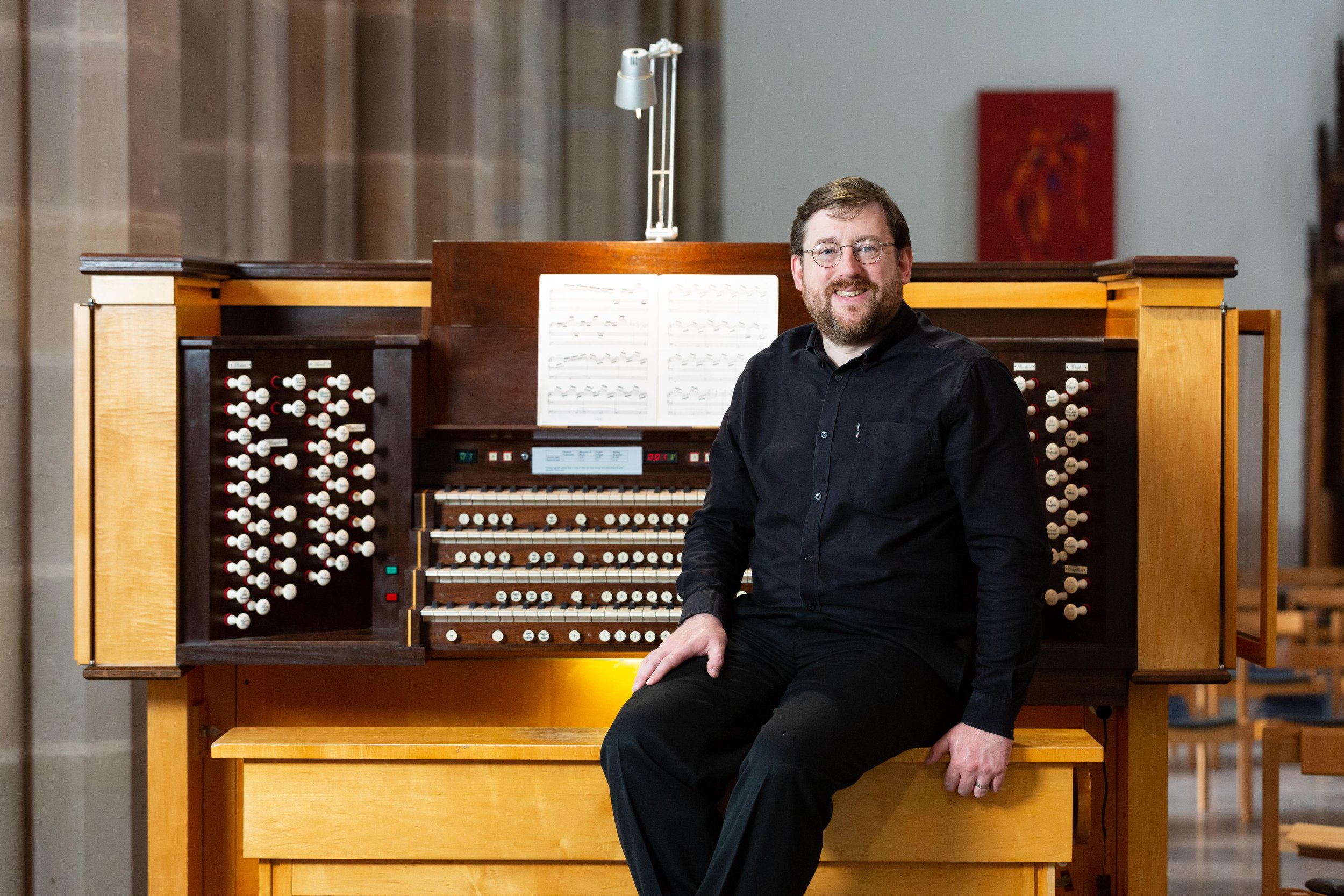
The venue was Reading concert hall, also home to Reading Museum, and the famous Father Willis Organ, on which the Poulenc Organ Symphony was performed, with wonderful soloist David Pether.
My piece is in three-movements (about 15 minutes) for Wind, Brass and Percussion only. The reason for this is because the strings were de-tuned to accommodate the organ’s sound, which, after having been restored to its original condition, was almost a quarter-tone sharper than modern concert pitch. The piece for Wind, Brass and Percussion as an ‘overture’, meant that the Poulenc could be played immediately afterwards, and the string players had the interval to re-tune for the Tchaikovsky No.6 ‘Pathétique’ in the second half.
I first submitted the piece, ca.19th November. The first read-through by the orchestra was on the 12th of December, after which they were invited to write feedback on the parts. Andrew went through all these comments and summarised them into an email for me, along with contact details for some of the players.
The suggestions were varied, but the recurring theme seemed to be: ‘make it more challenging; we can do more’. I was delighted. As composers, we’re often confronted with: “it’s too difficult..can’t do it..”, or “its really awkward to play…”. In the case of Stravinsky, or Shostakovich, you don’t have a choice..but that said, there is a difference between very difficult and impossible to physically play! I’m a composer who considers practicality when writing, but I never thought I’d find a group of players who would insist that I write more challenging music. It was enormously refreshing. When I was writing the piece initially, I told myself “I am writing for an amateur orchestra”, but the Aldworth Philharmonic, as I soon learned, is no ordinary amateur orchestra. The players really do strive for perfection. They work hard and they find fulfillment in doing so.
I spent another month working on the piece, injecting more fluidity into the music; complicated woodwind flourishes and loud, ambitious textures to add an extra layer of excitement and colour to the piece. The changes I made weren’t just orchestrational, but also structural. I had never written a piece for wind band, never mind the strange ‘not-quite-wind-band’ sonic properties of an orchestra’s wind, brass and percussion sections. I decided to write something that had a consistent rhythmic drive, with rousing, fanfare-like sections and meaty percussion, balanced by a modal lyricism in the very detailed woodwind parts. My third movement was particularly enhanced by the players feedback. The flautists suggested that I incorporate some of the obscure brass rhythms into the woodwind parts, which I explored further and ended up developing, and the horn players made detailed suggestions about how to use the horns as a section, rather than individual lines.
At the first rehearsal of the finished piece (8th Jan), I became incredibly nervous as the players seemed to struggle with my now more complicated rhythms. I’ve so often been told by professors, conductors and composers alike to ‘relax’ at the first rehearsal. It’s easy to forget how the performance of a piece can progress each time it’s played, and let’s not forget that these players were sightreading the piece. After a few more play-throughs and decisions about tempi, the piece was on its way to becoming more polished. As usual my main mistakes were tempo markings, and decisions about rhythm. Andrew decided to conduct the first movement in 6 quaver beats rather than 2 sets of 3, and we took down the tempo. This worked very well, and I began to see that it perhaps could have been written as a slower tempo, in 3/4. There were other orchestrational mistakes for which I kicked myself (I had ignored the rules about horns doubling to match trumpets/trombones above a certain dynamic, and also under-used the woodwind at times, making it difficult for Andrew to identify where the focal point of the piece was in certain areas). I fixed these errors in rehearsal by changing dynamics and making some cuts, but some of those mistakes were so obvious to me, and I was annoyed at myself.
The following weekend I came back and was immediately reassured by some of the players that they were ‘really getting the hang of it now!’ The piece sounded twice as polished as the previous weekend, and they proceeded to do some great work on it in the three hours rehearsal time. In the final hour of rehearsal, on the day of the concert, I took a step back and let Andrew decide what needed to be looked at. By that stage I was feeling pleased and confident about the performance and knew it would all be fine.
The players did a fabulous job; the performance was the best they had ever played it. I was very nervous; not because I thought they wouldn’t pull it off, but because a new piece is deeply personal. When it comes to the audience, I’m conscious of every shift in movement, every sniff, cough and sideways glance. I don’t think that’s neccessarily a composer mindset; perhaps it’s just my own neurotic perspective. All my senses are somehow heightened for those ‘however-many-minutes’ of psychological torment, somewhere halfway between the ‘buzz’ of having your ideas brought to life and the stress of being acutely aware of every minor slip in the performance. I imagine it’s a similar sensation for the conductor. Being involved in the essence of a musical performance is like being in a different dimension – you lose touch with time and your surroundings.
My nerves were justified by the fact that it was the biggest audience I’d had (apart from ‘Sounds’ at the NCH last March). I got some nice comments at the interval and afterwards, from strangers in the audience, which was a nice bonus – I worked very hard on this piece! I was definitely delighted with the performance, and my on-stage congratulations to Andrew and the players was very heartfelt.
BBC Singers Recording
Here is the recording of my piece ‘Breathe Shine Seek’ (ca. 4 mins) from the BBC Singers Workshop, on Tue 26th Oct. The recording was done by Jude Obermuller, also a participant in the workshop.
Audio clip: Adobe Flash Player (version 9 or above) is required to play this audio clip. Download the latest version here. You also need to have JavaScript enabled in your browser.
BBC Singers Workshop
Today I took part in a workshop with the BBC Singers at Maida Vale Studios. It was co-ordinated by The Royal College of Music in collaboration with the BBC Singers. The workshop was led by Gabriel Jackson and David Hill (Conductor). There were a number of RCM Composers involved; all having written pieces lasting 3-6 minutes. One of the pieces was my ‘Breathe, Shine, Seek’ (based on a poem by John Donne).
I was really impressed with the Choir – they sightread extremely difficult pieces and seemed to pluck notes out of thin air. They had a repetiteur/pianist present to help them with the pitches as all the pieces were written for choir a capella.
My piece was the second – at about 11.45am. I was initially concerned about the time constraints (we were given 35 mins approx per piece), but it worked out perfectly as the singers sightread everything almost flawlessly at once, and some of the pieces were more challenging than others, so they were allowed more/less time. I ended up getting about 40 minutes which was perfect.
I learned a few things – firstly about layout; I need to create Ossia-type staves rather than dividing up the line, and put one line of text above the stave if there is an elaborate divisi passage. (Alison warned me that this would be mentioned, but I’d already handed in the piece by the time I showed it to her).
Also – comments were made about my metronome marks (I’d written the piece in 3 or 4 days as there was about a month’s notice for the workshop..not including ‘rumours of’ the workshop, and I’d been working on something else at the time). The metronome marks were a bit inaccurate and some sensitive suggestions were made by David about varying it a bit more, most of which I took on board and worked out really well. I also changed a couple of dynamics based on balance (solos etc) and learned something about the subtle difference between grace notes ‘on the beat’ and accented semiquaver upbeats. A debate was triggered over whether the composer or the conductor should be responsible for the tempo variations. I thought: Surely the composer is responsible, but the conductor can create a unique interpretation based around the directions…(?) David Hill reminded me that some composers are more meticulous than others when it comes to directions, and don’t want their ideas to be ‘meddled with’.
My poem gets pretty dodgy towards the end – I only used the first few lines. Jude told me that John Adams used the exact same poem in ‘Doctor Atomic’ (with more of a ballady setting), which surprised me, as since I started setting it all I could think of was what a terrible choice I’d made…! It did work out though, apart from the whole ‘Battered Cod’ joke it evoked (again thanks Alison, for the heads-up)! Text below for the few lines I used:
Batter my heart, three-personed God; for you
As yet but knock, breathe, shine, and seek to mend;
That I may rise and stand, o’erthrow me, and bend
Your force to break, blow, burn, and make me new.
I, like an usurped town, to another due,
Labor to admit you, but O, to no end;
| BATTER my heart, three person’d God; for, you | |
| As yet but knocke, breathe, shine, and seeke to mend; | |
| That I may rise, and stand, o’erthrow mee,’and bend | |
| Your force, to breake, blowe, burn and make me new. | |
| I, like an usurpt towne, to’another due, | 5 |
| Labour to’admit you, but Oh, to no end, |
International Congress of Musical Signification.
Me giving my talk today (see previous entry for abstract). Excuse the blurriness. The paper went well; I think it was fairly clear. It was noted that all my research subjects were very young: (21-26) and that their common views/experiences might have something to do with this. I might ask the same gang of people in fifty years whether their philosophy and views about the composer/audience relationship has changed at all…!
I was told it was comprehensive and it did provoke a lot of questions and discussion. I was pleased to find that a handful of the audience were Composers, and I had a good crowd of 16 or so; not bad seeing as I expected about 4! Memorable questions asked afterwards were: “Do you imagine yourself as an audience member while composing?” and “Do you think that we can be conditioned to experience clear emotions through atonal music?” The ‘emotions’ thing becomes a little clichéd, but I defended the next speaker (Piotr Podlipniak) when he was attacked for his over-use of the term, in his research on ‘The universal aesthetic value of tonality and the ubiquity of tonal music‘ (already a provocative topic)! I made the point that for a lay audience, emotion is the first port of call in their attempt to encode what they hear (back to the ‘Constructivist theory’ about people not just passively receiving sensory input but being inclined to find meaning somehow). As children we often learn about classical music in this way; we identify major and minor keys by their potential to express certain ‘moods’. Speaking of moods, there was another talk on Tuesday about how we have to connect a mood to someone, or a legimate circumstance – so, a landscape can’t really be ‘gloomy’, but a painting of a landscape can be etc (Krzysztof Guczalski: Expressive meaning of music – a pioneer conception).
The main ‘discoveries’ in my research were:
A. The majority of composers suggested pre-concert talks or programme notes as a means of explaining to the audience what their music is about. This was interesting considering that a couple of the composers had elsewhere in the questionnaire insisted that the wider audience’s response was irrelevant to them. By insisting on these tools to translate their musical ideas, they are actively imposing a certain meaning on the piece for the audience, so therefore they must be at least a little concerned about how the audience hears the piece.
B. There was a divide in the mindset of some of the composers I questionned, between those who used the lay audience’s ‘ignorance’ as an inspiration to ’write to challenge’ and those who decided that to acknowledge the audience as an important factor would inevitably hinder their development.
There were other little discoveries but I think those two were particularly important. I gave the audience a printed copy of some (anonymous) answers from the composers I used as research subjects.
ICMS XI, Krakow
Behold, my conference paper for the ICMS in Krakow. Below it is my blog/diary:
Axiology, Constructivism, and Schemata: The Composer’s Perspective
Solfa Carlile, Royal College of Music, London
Chopin was a composer of great depth and power who had to fight against the simplifying myths of nineteenth century which saw him as a salon, romantic or Slavonic composer (Samson, 1992). As a composer herself, the author of this paper is acutely aware of the tensions between the values she assigns to her music and the values ascribed to it by her audience.
This paper approaches the issue from the constructivist perspective – not the musical constructivism of Borys Liatoshynsky and his contemporaries – but the constructivist theories popular in sociology, philosophy and pedagogy which claim that people actively construct meaning for themselves rather than merely receive it.
The paper utilises the concept of a ‘schema’ (Bartlett, 1932) to consider how the reception of a new work and the value ascribed to it will depend on the already constructed schema in the minds of audience members drawn from previous experience. Both the audience and the composer face a challenge in understanding and appreciating one another’s point of view. It must be acknowledged however, that schemata dictate whether or not a piece is successful in anyone’s individual opinion. Drawing on examples of her own work, the author, as a composer herself articulates the axiological dilemma implicit in composition and concludes that the composer, rather than trying to please her entire audience, must overcome axiological angst and remain true to her unique style of writing.
References
Bartlett, F.C (1932) Remembering: A Study in Experimental and Social Psychology, Cambridge: Cambridge University Press.
Samson, J (1992) (ed) The Cambridge Companion to Chopin, Cambridge: Cambridge University Press
_________________________________________
It’s not at all as difficult as it sounds – in fact, it’s very straightforward and accessible!
I am writing this from a hotel room near the Academy of Music in Krakow, where the 11th International Congress of Musical Signification is taking place. I arrived on Tuesday and attended a few talks, including a lecture by Mieczysław Tomaszewski on Expressivity in the music of Chopin (C is a hot topic for many of the presentations, it being the 200th anniversary of his birth).
Today we went on a trip to Zakopane, to the Karol Szymanowski museum. It was a small house where he lived for many years. We heard a concert there and then went up a mountain to take photographs and browse some market stalls. In the late afternoon/evening we had a traditional Polish meal in a restaurant and heard some traditional music by a small costume-attired band (three Violinists and a ‘Cello, all singing). We saw some amusing sights; a little run-down hut with a guy selling oranges, and some great little shops selling furs, hats and leather very cheaply.
Constructivism is a topic I’ve been preoccupised with for a while. It basically deals with how we all hear a piece differently based on our past experiences of music. It explains why not everybody likes or understands a certain piece of music. It also means that composers and audience ascribe different values to music, causing rifts in communication between both sides. My research was done by asking colleagues and fellow students about how they overcame this, if indeed it bothered them at all.
New York Trip
Last week, for two days (Tues-Thurs) I had the honour of staying in Connecticut with legendary orchestrator William David Brohn. This was all thanks to the aforementioned Septimus, who makes my life all the more interesting..! He first met Bill in 2006, following a performance of ‘Mary Poppins’ at the Prince Edward Theatre in London. Tim had been a fan of Bill’s since the 1994 re-orchestrated revival of ‘Oliver!’, and thankfully decided to tell him so. Thus began a wonderful friendship, which resulted in ‘Broadway to West End by Special Arrangement’ – a massive gala last year at London’s Drury Lane theatre, in honour of Bill, which was co-produced and created by Tim. Bill’s most famous scores are probably ‘Wicked’ and ‘Ragtime’. He counts his ‘West Side Story Suite’ (for Joshua Bell) as a work that is particularly special and personal to him.
Bill was working on a re-orchestration of Michel Legrand’s ‘Marguerite’ – which premiered in London in 2008, and I happened to see three times (!) but has since been re-written, book and score. The songs have been changed and this forthcoming production also has a larger band. We heard a demo by Michel Legrand and his wife, performing ‘China Doll’ from Marguerite- originally for solo female but re-written as a duet. We were delighted to discuss the production with Bill, who hadn’t seen the show in performance. I also highlighted a couple of accidentals in the harp writing, which I thought might have been an interesting modal effect but turned out to be a pedal error!
I noticed that Bill’s orchestration style is characterised by a lot of individual, lyrical lines and countermelody, rather than filling in a particular harmony. It’s very refined and creates a sense of polyphony, but still emphasises the vocal line. At times it can be very thick and hearty as well, such as in ‘Journey On’ from Ragtime, and the Gershwin arrangements for Joshua Bell. I noticed the glorious orchestral combination of Gran Cassa, Tubular Bells and Timps for a combined dramatic ‘thud’!
I played ‘Entwining Brances’ (finale) from my ‘Deirdre and Naoise‘ for Bill, and he was very complimentary about it. He liked the fruity ‘Cello solos, and strangely didn’t complain about the Glock, though it’s the biggest problem in the piece for me. There are things about the orchestration that I would change considerably now, but I guess it was a good effort for the stage I was at four years ago. At Bill’s I also studied the full (orchestral) score for ‘Ragtime’, and ‘Ragtime Symphonic Suite’ (of which I had recordings). I also had the honour of studying the score for Stephen Schwartz’s recent opera, ‘Seance on a Wet Afternoon’, and met Schwartz briefly on the Thursday morning before leaving for New York. ‘Seance’ is a beautiful diatonic work which is the kind of thing I was hoping for in Rufus Wainwright’s ‘Prima Donna’, but didn’t quite get! The arias definitely had the distinct ‘Schwartz’ trademark on them.
As for the Broadway Shows, I can recommend Bacharach’s ‘Promises Promises’, and as always ‘Mary Poppins’! The orchestration is of course, stunning. I took a sneaky photo of Bill’s Tony Award for Wicked, which I will upload at some point after Tim does the photos.

Broadway to West End